
Cohort 3
-
Ismael Ahlouche
 Research interests:Mathematical Explorations of the kinematical Erlangen ProgrammeInstitution:University of Edinburgh
The kinematical Erlangen Programme can be summarised as “physics from symmetry”. Its Klein geometries can be interpreted as spacetimes, with kinematical Lie groups as their symmetry groups. Starting from a kinematical Lie group, one can establish the following dictionary: Classical free particles correspond to homogeneous symplectic manifolds. Quantum free particles and classical free fields correspond to projective unitary irreducible representations. The aim of this PhD thesis would be to investigate how this programme can be extended to strings and other extended objects.
Fun fact: I don’t know how to ride a bike.
-
Luca Bin
Research interests:Conformal field theories and RG flowsInstitution:Heriot-Watt UniversityMy research is in two-dimensional conformal field theory, and in particular in what happens when we move away from the fixed point. Perturbing a CFT by a relevant operator triggers a renormalisation group flow, and I am interested in how much of this flow can be understood using data of the UV theory. In particular, I study constraints coming from topological defects and from the structure of boundary conformal field theories.
More broadly, I am interested in the structural and non-perturbative aspects of quantum field theory, and in how these ideas apply across different areas of physics, from condensed matter to high energy physics and quantum gravity.
My research is in two-dimensional conformal field theory, and in particular in what happens when we move away from the fixed point. Perturbing a CFT by a relevant operator triggers a renormalisation group flow, and I am interested in how much of this flow can be understood using data of the UV theory. In particular, I study constraints coming from topological defects and from the structure of boundary conformal field theories.
More broadly, I am interested in the structural and non-perturbative aspects of quantum field theory, and in how these ideas apply across different areas of physics, from condensed matter to high energy physics and quantum gravity.
-
Rehmat Singh Chawla
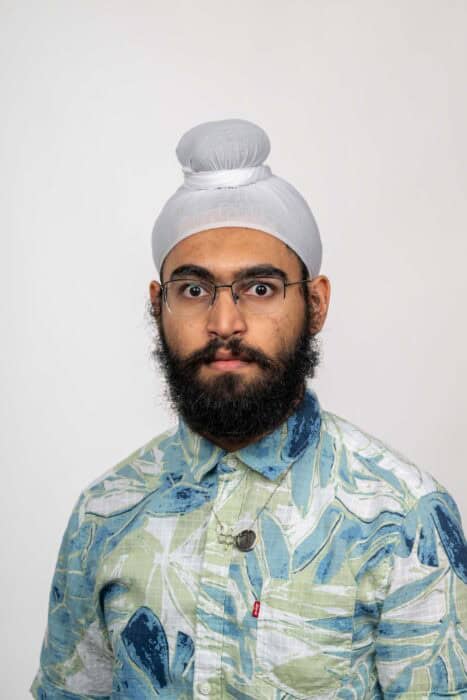 Research interests:Quantum Field Theories and GravityInstitution:University of Edinburgh
My current project is “Discretised Gravity using Differential Forms”
Theories of gravity, including Einstein gravity, can be expressed purely using differential forms — this is especially useful when coupling fermions to gravity. Differential forms can also be naturally discretised on simplicial complexes. I’m looking into what this tells us about gravity and fermions on a discrete space, for simulations and hopefully also for fundamental insights about quantum gravity.
My other research interests include renormalisation, generalised symmetries, higher-form electromagnetism, and matrix models
-
Elliot Ferguson
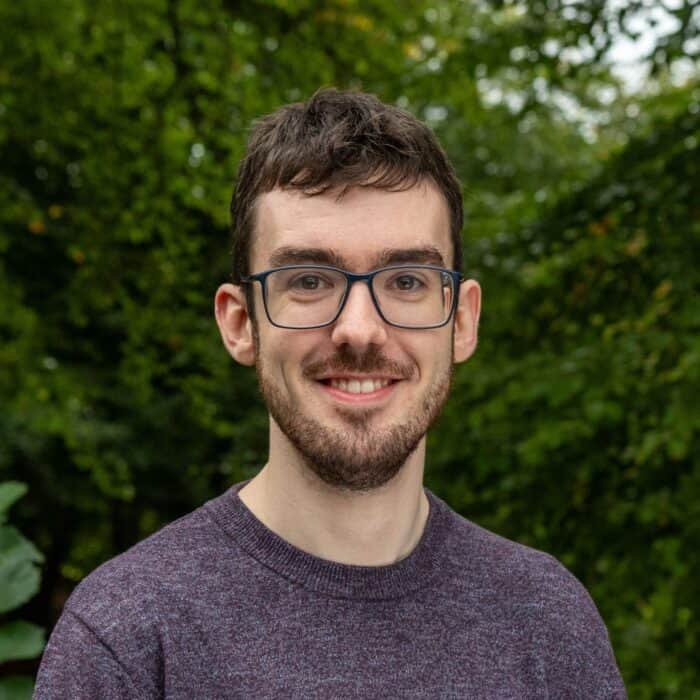 Research interests:Class Groups and Arithmetic StatisticsInstitution:University of Glasgow
My interests lie in the branch of number theory known as arithmetic statistics, which is concerned with studying the typical behaviour of arithmetic objects in families. I am particularly interested in the Cohen–Lenstra heuristics on the distribution of class groups of number fields and their generalisations to ray class groups.
My interests lie in the branch of number theory known as arithmetic statistics, which is concerned with studying the typical behaviour of arithmetic objects in families. I am particularly interested in the Cohen–Lenstra heuristics on the distribution of class groups of number fields and their generalisations to ray class groups.
-
Rudra Kamat
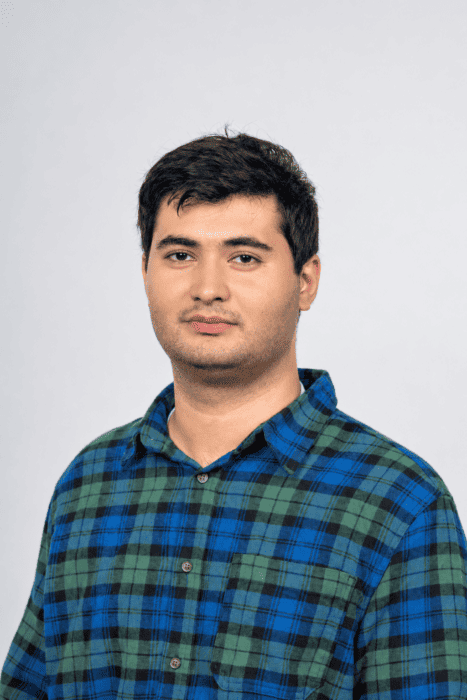 Research interests:Higher Symmetries and QuantisationInstitution:Heriot-Watt Univeristy
I am currently interested in multisymplectic quantisation, namely applying multisymplectic geometry and higher Courant algebroids to field theory with the aim of building frameworks for classical field theories and their quantisation beyond the standard symplectic setting.
Outside work, I enjoy writing poetry, composing music, studying classical languages, and making educational YouTube videos.
-
Mira Kiwan
 Research interests:Representation theoryInstitution:University of Glasgow
I am interested in the representation and character theory of Kac-Moody algebras and related objects, such as affinisations. In particular, I am interested in Macdonald theory and its generalisation to affine Lie algebras.
I am interested in the representation and character theory of Kac-Moody algebras and related objects, such as affinisations. In particular, I am interested in Macdonald theory and its generalisation to affine Lie algebras.
-
Elsa Lang
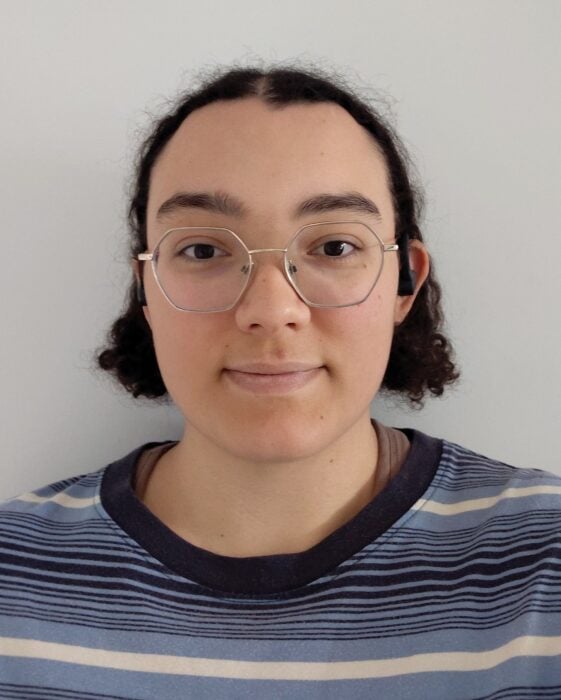 Research interests:Energy Correlators and HolographyInstitution:Heriot-Watt University
My research centres on using quantum field theories with stronger symmetries, and dualities between theories, to gain information about collider observables. Specifically, this involves looking at energy correlators in CFTs and using the AdS/CFT correspondence. I am also interested in the larger structure of light-ray operators and holographic dualities between gauge and gravitational theories.
My research centres on using quantum field theories with stronger symmetries, and dualities between theories, to gain information about collider observables. Specifically, this involves looking at energy correlators in CFTs and using the AdS/CFT correspondence. I am also interested in the larger structure of light-ray operators and holographic dualities between gauge and gravitational theories.
-
Lorenzo Pascarella
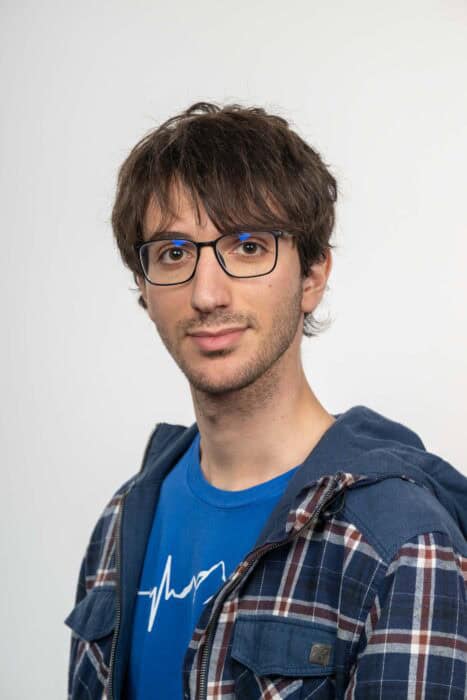 Research interests:Aspects of derived geometryInstitution:University of Edinburgh
The project investigates applications of homotopy theory to geometry, whether algebraic, differential, or analytic. Recently, I have been working on the differential and analytic aspects.
The project investigates applications of homotopy theory to geometry, whether algebraic, differential, or analytic. Recently, I have been working on the differential and analytic aspects.
-
Nikolai Perry
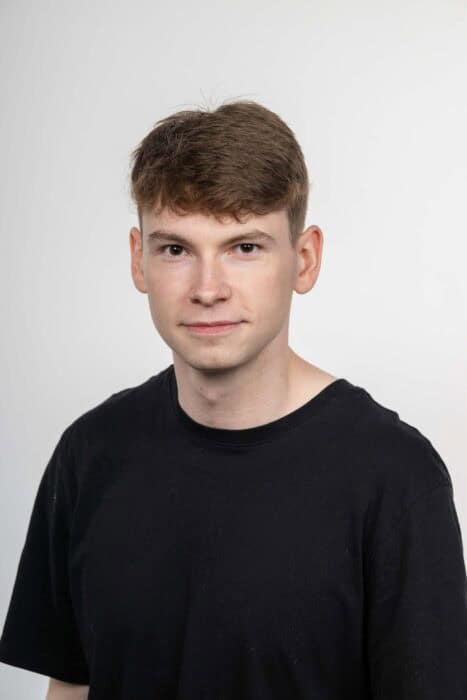 Research interests:Topological quantum field theories, Tensor categoriesInstitution:University of Edinburgh
I am currently interested in interactions between algebra, low dimensional topology, and (higher) category theory. Topics of interest include Skein theory and TQFTs. My recent work has focused on (1) applying tools and techniques from category theory to understand Lie algebraic structures arising from quivers, and (2) using factorization homology to understand quantizations of character (super)varieties.
I am currently interested in interactions between algebra, low dimensional topology, and (higher) category theory. Topics of interest include Skein theory and TQFTs. My recent work has focused on (1) applying tools and techniques from category theory to understand Lie algebraic structures arising from quivers, and (2) using factorization homology to understand quantizations of character (super)varieties.
-
Daniel Phillips
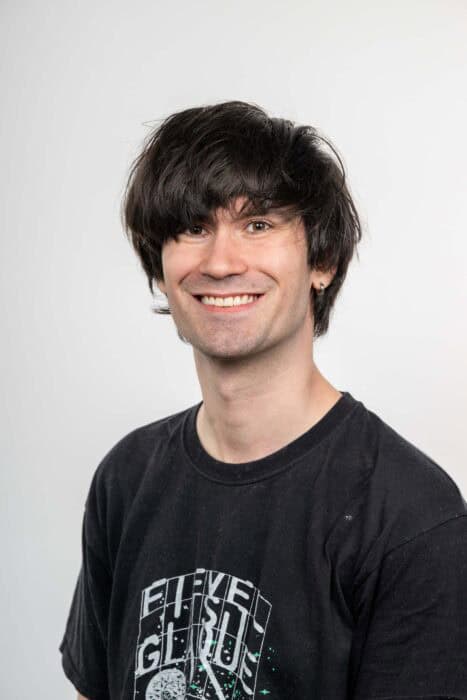 Research interests:Geometric group theory, low-dimensional topologyInstitution:University of Glasgow
My interests lie in the intersection of low-dimensional topology and geometric group theory. I am particularly interested in mapping class groups of surfaces, braid groups, and the various geometric spaces that these groups act upon (e.g. Teichmüller spaces, character varieties, curve complexes). Right now, I am looking at the kernel of the Burau representation and investigating its underlying structure.
My interests lie in the intersection of low-dimensional topology and geometric group theory. I am particularly interested in mapping class groups of surfaces, braid groups, and the various geometric spaces that these groups act upon (e.g. Teichmüller spaces, character varieties, curve complexes). Right now, I am looking at the kernel of the Burau representation and investigating its underlying structure.
-
Bartosz Prech
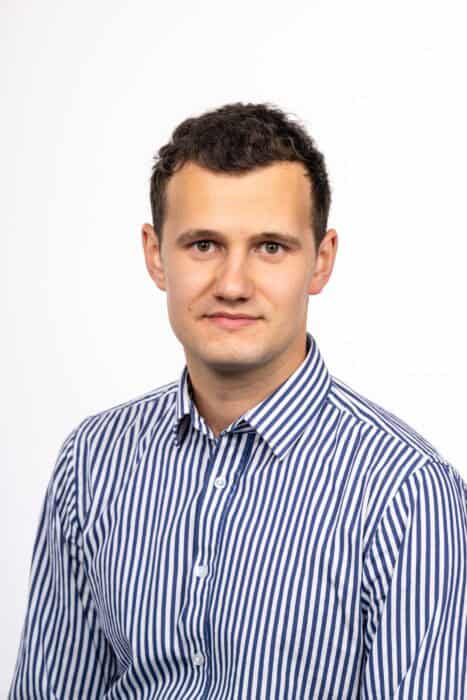 Research interests:General relativity and field theoryInstitution:University of Edinburgh
My current research aims to better understand the properties of gravity and field theory in asymptotically flat spacetimes by applying methods of Carrollian geometry. Besides that, I am fascinated by black hole horizons (and their local counterparts, i.e. isolated horizons), and occasionally pursue topics in (quantum) field theory.
In my free time I enjoy running, playicg chess and reading books.
-
Alex Thorne
Research interests:The early Universe, the Standard Model and mathematical quasicrystalsInstitution:University of EdinburghRight now, I’m investigating the relationships between algebraic number theory and self-similar quasicrystals like the Penrose tiling, and trying to figure out what these relationships could tell us about fundamental physics
Right now, I’m investigating the relationships between algebraic number theory and self-similar quasicrystals like the Penrose tiling, and trying to figure out what these relationships could tell us about fundamental physics