
CONFERENCE SCHEDULE
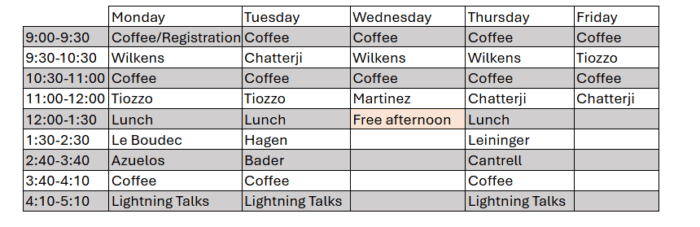
MINI-COURSES
Indira Chatterji
Title: Property (T), median spaces and the rapid decay property.
Abstract: First hour: Basics on Kazhdan’s property (T) and a characterization in terms of actions on median spaces.
Second hour: CAT(0) cubical complexes as examples of median spaces. Groups acting on those objects have a strong negation of property (T) (the Haagerup property, or a-T-menability).
Third hour: The rapid decay property and median geometry.
Giulio Tiozzo
Title: Poisson boundaries for random walks on hyperbolic-like groups
Abstract: The Poisson boundary of a random walk on a group is a measure-theoretic object that, as Furstenberg realized, captures the space of bounded harmonic functions on the group. On the other hand, often in geometric group theory and topology we have groups that act by isometries on certain spaces (in particular, spaces of negative curvature, in a certain sense), and these spaces come equipped naturally with a topological notion of boundary arising from the geometry of the space. It is a recurring question in this context whether the geometric boundary can be identified with the Poisson boundary.
In this mini-course, we will study random walks on groups with hyperbolic properties (in particular, hyperbolic groups and mapping class groups) and show that, under a finite entropy assumption, the Poisson boundary coincides with the geometric boundary.
A central topic will be the entropy theory of random walks on groups.
Amanda Wilkens
Title: The ideal Poisson–Voronoi tessellation and some applications
Abstract: We will start by defining and motivating the Poisson point process, which is, informally, a “maximally random” scattering of points in space, and discussing the ideal Poisson–Voronoi tessellation (IPVT), a new random object with intriguing geometric properties when considered on a semisimple symmetric space (the hyperbolic plane, for example). In joint work with Mikolaj Fraczyk and Sam Mellick, we use the IPVT to prove a result on the relationship between the volume of a manifold and the number of generators of its fundamental group (for higher rank semisimple Lie groups, the minimum number of generators in a lattice is sublinear in the covolume). In this minicourse we will unpack the proof, focusing on the elementary dynamical argument at its heart. No prior knowledge on Poisson–Voronoi tessellations, fixed price or higher rank will be assumed.
RESEARCH TALKS
Penelope Azuelos
Title: A flat torus theorem for hierarchically hyperbolic spaces
Abstract: Hierarchically hyperbolic spaces (HHSs) are metric spaces which exhibit a coarse but highly organised form of nonpositive curvature. They provide a common generalisation of mapping class groups and compact special groups (e.g. right-angled Artin groups) where one can hope to adapt methods from either setting. I will present a ‘coarse flat torus theorem’ for these spaces which provides a uniform quality, invariant, cocompact quasi-flat for any virtually abelian group acting sufficiently nicely on an HHS. The more detailed version of theorem has a number of consequences for hierarchically hyperbolic groups, including a geometric description of the normalisers and centralisers of virtually abelian subgroups and an ascending chain condition for virtually abelian subgroups. This talk is based on joint work with Mark Hagen.
Shaked Bader
Title: Higher Property (T) and a Fixed Point Theorem
Abstract: Property (Tn) is a group property introduced by U. Bader and R. Sauer, defined by the vanishing of the cohomology groups of G with L2-coefficients up to degree n. They showed that simple Lie groups have property (Tn) for n=rank−1. We prove a similar result for Lp-coefficients, confirming a conjecture of Gromov in the special case of L^p(G).
The case p=1 is of particular interest. We relate the vanishing of L1-cohomology to a fixed point theorem and confirm a conjecture of Farb. Farb conjectured a fixed point property for actions of lattices in such groups on CAT(0) cell complexes of dimension lower than the rank.
In this talk, I will give a short introduction to group cohomology and discuss ideas from the proofs of both results. This talk is based on joint work with Saar Bader, Uri Bader, and Roman Sauer.
Mark Hagen
Title: Walls in groups with cyclic hierarchies and JSJ-like splittings
Abstract: The results in this talk are motivated by the tricky question of which free-by-cyclic groups act freely on CAT(0) cube complexes; many are known to have such actions, and counterexamples are not known. I will briefly survey the known positive results before turning to the case where there has only been partial progress, namely mapping tori of free group automorphisms for which word lengths grow polynomially under iteration. Such groups can be studied using some very useful splittings constructed by Macura (for the superlinear growth case) and by Andrew-Martino and Dahmani-Touikan (linear case). The latter is very similar to the JSJ decomposition of a 3-dimensional graph manifold, and this analogy is useful. I will present some combinatorial/topological techniques for cubulating groups using such splittings, under certain extra conditions, and explain when these techniques apply in the polynomially-growing free-by-cyclic case. For example, in a reasonable sense, “generic” mapping tori of polynomially-growing automorphisms of free groups are freely cubulated. I will explain the core difficulty with promoting that “generic” to “all” via an intriguing example. This talk is mostly based on recent joint work with Dani Wise.
Adrien Le Boudec
Title: Lattices determined by their commensurator
Abstract: Let G be a locally compact group, and Gamma a lattice in G. The commensurator of Gamma in G is the set of elements g in G that conjugate Gamma to a subgroup commensurable with Gamma. Although Gamma is discrete in G, it is a frequent phenomenon that the commensurator of Gamma in G is a dense subgroup of G. In that setting we address the problem whether Gamma is determined by its commensurator. The focus will be on the situation where G is a totally disconnected group, and Gamma is a finitely generated cocompact lattice. We establish general rigidity results ensuring Gamma can be abstractly recovered from its commensurator in G. Situations where those results apply include cocompact lattices in automorphism groups of trees (answering a question originally due to Bass-Kulkarni), as well as graph product of finite groups in automorphism groups of right-angled buildings. Joint work with Colin Reid.
Chris Leininger
Title: Symbolic coding of billiards and geometric rigidity
Abstract: I’ll discuss joint work with Duchin, Erlandsson, and Sadanand on billiards in polygons with polygonal obstacles. The symbolic coding of the billiard flow records the bininfinite sequence of sides of the boundary and obstacles encountered billiard trajectories. We completely answer the question of the extent to which the symbolic coding determines the shapes of the polygons and relative locations of the obstacles. The proofs involve analysis of non-positively curved cone metrics on surfaces and the geometry of their universal covers, as well as constructions of homeomorphisms of surfaces with boundary from the coding.
Diego Martinez
Title: A Gelfand-type duality and C*-rigidity for metric spaces
Abstract: Given a (usually proper) metric space Roe introduced several
“geometric” C*-algebras associated to it. Heuristically these are
algebras of operators on the space that move the space “only so much
away”. It was an original observation of Roe, moreover, that two of
these algebras are isomorphic (as C*-algebras) as soon as the spaces are
coarsely equivalent, i.e. they share exactly the same properties at
infinity. The converse of this became known as the C*-rigidity of metric
spaces, and has seen quite a lot of work. In this talk we will discuss
the (positive) solution which, furthermore, allows to discuss a
Gelfand-type duality between the space itself and the outer
automorphisms of the Roe algebra. This is based on joint work with
Federico Vigolo.
Stephen Cantrell
Title: The space of metric structures on RAAGs
Abstract: We will introduce a moduli space of metrics on right angled Artin groups which we equip with a metric that mimics the Thurston metric on Teichmüller space. We’ll discuss the geometric properties of this space and, time permitting, explain how to connect metric structures by geodesics coming from `Manhattan curves’.