
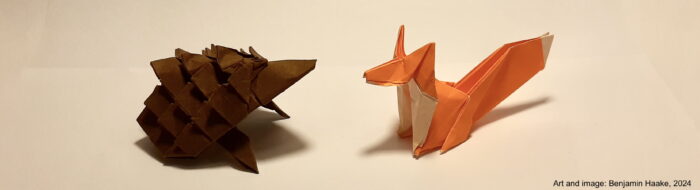
Fox & Hedgehog Seminar
The Fox and Hedgehog seminar, established in 2023, aims to forge closer ties within our broad academic community: between mathematicians and physicists, and between junior and senior members. The seminars are a collaboration among the various partner institutions in the AGQ CDT: the schools/departments of mathematics at Glasgow, Edinburgh, and Heriot-Watt, and the Higgs Centre for Theoretical Physics. The target audience of this series is PhD students, although any and all interested staff and students are always welcome to attend.
In an article in the New York Review of Books, Freeman Dyson writes, “Great scientists come in two varieties, which Isaiah Berlin, quoting the seventh-century-BC poet Archilochus, called foxes and hedgehogs. Foxes know many tricks, hedgehogs only one. Foxes are interested in everything, and move easily from one problem to another. Hedgehogs are interested only in a few problems which they consider fundamental, and stick with the same problems for years or decades… Science needs both hedgehogs and foxes for its healthy growth, hedgehogs to dig deep into the nature of things, foxes to explore the complicated details of our marvelous universe.”
Every two weeks, we invite a member of our community to give a pedagogical blackboard talk aimed at a broad audience of PhD students from mathematics, mathematical physics, and theoretical physics. Every speaker will be asked to answer the following:
– What is one big problem/idea in your field, and why is it interesting/motivating to you?
– How did you first encounter this problem/idea? How did you come to approach it, and how has your thinking and methodology developed along the way?
– Are you a Hedgehog or a Fox?
The seminar will alternate among our different physical locations, always available online. For in-person participants, the seminar will be followed by refreshments and a half-hour informal discussion, starting with “a day in the life” of the speaker.
Student organisers: Maegan Anderson (UoE/Higgs), Giorgio Frangi (Higgs), Rafaela Ioannou (HW), Willoughby Seago (UoG)
Staff contacts: Clark Barwick (UoE), Vaibhav Gadre (Glasgow), Anton Ilderton (Higgs), Alessandro Sisto (HW)
Administrative contact: Emma Johnston (Higgs)
Upcoming Seminar:
-
Fox & Hedgehog will return after the summer!
Semester 2:
-
29 January, 2026, 11:00am-12:30pm, Higgs Centre, Edinburgh (JCMB 4305)Speaker: Geoff Vasil
Uncounting polynomials
For my research day job, I solve differential equations on computers. I do this by appropriating many of the special functions of mathematical physics to keep track of all kinds of information in numerical form. But looking at the inner workings of those functions leads to the striking observation: spherical harmonics, Bessel Functions, Chebyshev polynomials, Hermite functions, Bernoulli polynomials, and many more are all littered with the trappings of combinatorics: factorials, monomials, binomial coefficients, Stirling numbers, and much more.
Often, combinatorics researchers apply their trade by proposing a concrete or abstract situation and hunt for formulas that “count” the number of possibilities. The process sometimes works in reverse, but much less so. In that case, you start with a formula and ask, “What real-life scenario is this counting?” However, a perennial difficulty about “uncounting” orthogonal polynomials is the common appearance of fractions, and even worse, negative numbers! To be clear: I want something that, when properly uncounted, could be performed on stage at the Fringe Festival. What are negative actors, exactly?
In this talk, I’ll outline some of the progress my PhD student, Miru Park, and I have been making on uncounting Laguerre polynomials and related problems. In the process, we’ve discovered that modern Category Theory seems to contain just the right tools: groupoids, weak actions, and the Grothendieck group for those pesky negatives. I’ll do my best to explain everything as elementally as possible, with the ultimate goal of using the abstract to uncover the concrete. -
5 February, 2026, 11:00am-12:30pm, Bayes Centre 5.46, EdinburghSpeaker: Matthew Cordes
Cannon-Thurston maps
Say you have a genus-2 surface and a diffeomorphism of that surface to itself, then you can make a 3-manifold by crossing that surface with the unit interval to form a “cylinder” and then use the diffeomorphism to glue one end of the cylinder to the other. Thurston showed that if you pick a nice homeomorphism (a pseudo-Anosov map), then you can give your 3-manifold a hyperbolic structure.As a geometric group theorist, I want to understand the relationship between the fundamental group of the surface and the fundamental group of the hyperbolic 3-manifold. (For those of the representation theory persuasion, this map is a representation of the surface group into PSL(2,C).) In this talk I’ll discuss what Cannon and Thurston discovered if you look at the “behavior at infinity” of these groups. Then I’ll close by telling you a bit about generalizations to this construction that I (and my coauthors) find interesting. -
19 February, 2026, 11:00am-12:30pm, 311b, Maths, GlasgowSpeaker: Gwyn Bellamy
Symplectic quotient singularities
If a finite group G acts on a complex vector space V then the set of orbits V/G is naturally an affine variety. It is almost always singular. Beginning with my PhD work, I’ve always been interested in resolutions of these singular spaces. I’ll explain what a “symplectic resolution” is, when these exist and why you might care about them. The main point of the talk is to use this example to illustrate some of the things that you’ll typically encounter, or require, in your research career e.g., luck, bad luck, hard work, mistakes… In other words, I’ll use this example to tell you some of the things that have happened to me during the almost 20 years spent thinking about the problem.
-
5 March, 2026, 11:00am-12:30pm, Higgs Centre, Edinburgh (JCMB 4305)Speaker: Franz Herzog
Feynman Graph Theory
Feynman graphs (or diagrams) and their associated Feynman Integrals are the building blocks of perturbative Quantum Field Theory, and thus serve as a basis for Standard model theory predictions for experiments such as the LHC. The higher the precision required the more complicated the integrals become. But their mathematical properties are also interesting in their own right. I will discuss the Hopf algebras of Feynman graphs, which underly renormalisation of UV and certain IR divergences, as well as certain asymptotic expansions. I will conclude with some applications in collider physics and condensed matter physics.
-
2 April, 2026, 11:00am-12:30pm, Glasgow Maths 311BSpeaker: Tara Brendle
The “mysterious” part of mapping class groups
The mapping class group of a surface S, denoted MCG(S), is its group of symmetries, or more precisely, its group of self-diffeomorphisms up to isotopy. Mapping class groups play a key role in many areas of mathematics, sitting at the interface between low-dimensional topology, geometric group theory, algebraic topology and complex dynamics. Specific examples of mapping class groups include the case of the torus, where the mapping class group is just GL(2, Z), and the case of a punctured disk, where the mapping class group is better known as the braid group.The group MCG(S) acts on the first homology group of the surface preserving the (symplectic) intersection pairing, but this action is far from faithful. Its kernel, the Torelli group of the surface S, is therefore often referred to as the “mysterious” part of the mapping class group. In the late 1970s and early 1980s, Dennis Johnson wrote a series of beautiful papers about the Torelli group, and answered many fundamental questions about its structure. In this talk, I’ll explain some aspects of Johnson’s approach to the Torelli group, and some of the fascinating questions that were answered and raised by his work. -
22 April, 2026, 14:00am-15:30pm, Glasgow Maths 311BSpeaker: Richard Schwartz
Optimization in paper geometry
I have always tried to pick research problems that are simply stated and have an experimental feel to them, subject to the constraint that I have some possibility of solving them. In short, I do what I can. I will talk about my recent forays into optimization problems related to paper geometry. First, I’ll sketch my proof of the optimal paper Moebius band conjecture, which tells you how long a strip of paper you need in order to make a paper Moebius band. Second, I’ll sketch my proof of the minimal vertex problem for origami tori, which answers the question of how many vertices (or folds) you need to make a torus out of paper. The second topic has lots of computer demos. -
23 April, 2026, 11:00-12:30pm, Maths Seminar room, Edinburgh (JCMB 5323)Speaker: Martin Evans
Nonequilibrium physics: a walk on the wild side
I will start with an overview of equilibrium statistical mechanics. Then we’ll consider the myriad ways a system can be out of equilibrium and why equilibrium is a special place. I’ll then present a few simple models that have been used to describe various nonequilibrium scenarios: nonequilibrium stationary states; boundary-induced phase transitions and condensation transitions. These models, such as asymmetric exclusion process, zero-range process, persistent random walkers, often originated in the probabilistic literature but found purpose and became better known in non-equilibrium physics. I’ll give a flavour of the mathematics that has been used in the solution of these models and the mathematics that has resulted from their solution. -
30 April, 2026, 11:00-12:30pm, Room S.1, 7 George Square, EdinburghSpeaker: Minhyong Kim
Who owns mathematics?
At a recent conference on the global history of mathematics, a question was raised about the recurrence of Euclid in a number of the talks and the ‘Western’ bias that seemed to appear in a meeting that was ostensibly concerned with mathematics in the world as a whole. In this talk, I will discuss the misconceptions around the identities of historical figures like Euclid, the deep-rooted confusion surrounding ancient identities in general, and why it might be important for mathematical scientists of our times to be aware of them. -
7 May, 2026, 11:00am-12:30pm, Glasgow (Maths 311b)Speaker: Mike Whittaker
Self-similar actions and their limit spaces
A self-similar group (G,X) consists of a group G acting faithfully on a homogeneous rooted tree such that the action satisfies a self-similarity condition. In this talk I will introduce a beautiful theorem of Nekrashevych: there is a self-similar group associated to every post critically finite rational function whose limit space recovers the Julia set of the function. I’ll then show how I’ve used limit spaces of self-similar actions in other contexts to understand dynamical systems.
Semester 1:
-
7 October, 2025, 3:30-4:30pm, Higgs Centre, Edinburgh (JCMB 4305)Speaker: Tudor Dimofte
Re-innovating the wheel: Tannaka duality and extended operators in QFT
Tannaka duality was developed in the late 1930’s in order to reconstruct a complex Lie group from its category of representations. Its generalization, more often simply called “reconstruction theory,” has now become a fundamental part of representation theory — in particular, representation theory of categories and higher categories. It was used in physics in the 1990’s (and the 2000’s… and again in the 2010’s…) to represent line operators in topological QFT’s — by folks like Freed, Witten, and Costello. I will talk about how I stumbled into it in the course of my work, was drawn in by its power, and have been seeking new applications.
-
21 October, 2025, 3:30-4:30pm, Bayes Centre area, Edinburgh (50 George Square G.01)Speaker: Kara Farnsworth
Symmetries of Renormalization Group Fixed Points
I will give a general overview of our current understanding of the symmetries of renormalization group fixed points in quantum field theory and why they are interesting, including scale, conformal and Weyl invariance. I will describe the distinction between these symmetries, as well as what is generally known about when these symmetries imply one another. I’ll also give an overview of my past and present work on this topic and how it’s evolved over my career.
-
25 November, 2025, 3:30-4:30pm, Higgs Centre, Edinburgh (JCMB 4305)Speaker: John Baez
Before and after the cobordism hypothesis
In 1995, James Dolan and I formulated a series of “hypotheses” about topology and higher categories, before the theory of higher categories was sufficiently developed to make these into precisely stated conjectures. In 2009 Jacob Lurie reformulated one of these using infinity-categories, called it the “cobordism hypothesis”, and gave a 111-page outline of a proof. Simply put, the cobordism hypothesis gives a purely algebraic description of smooth manifolds, helpful for constructing topological quantum field theories. I’ll say a bit about what led Dolan and me to this hypothesis, what it says, why it’s useful, and why I quit working on it.
-
2 December, 2025, 4:00-5:30pm, Maths Building, Glasgow (Room 331B)Speaker: Alex Bartel
Can you hear the shape of a drum?
I will explain the mathematical formulation of this tantalising question, will give a bit of an overview of what is known about it, and will tell you what Aurel Page and I recently contributed to the area. In the spirit of the seminar, I will explain how I, as a number/representation theorist, became interested in this question.
Past seminars:
For seminars from 2023-24 and 2024-25, visit our previous website.